February is Teen Dating Violence Awareness Month

Dating abuse is a dangerous pattern of behavior that can affect people of all genders, backgrounds, races, and ages-even teens! These dangerous patterns of behaviors, or abuse, allow one partner to hold power and control over the other. This power and control may be maintained through tactics like emotional or physical abuse, controlling behaviors, threats, and other ways. This power and control wheel is a simple example of the different ways abusers maintain power and control:

For a more in depth look at the teen dating violence power and control wheel, scan the QR code using your phone:

1 IN 3 TEENS WILL EXPERIENCE DATING VIOLENCE BEFORE THEY ARE ADULTS.

Some signs of an abusive relationship might be:

  • Isolating from friends or favorite activities because of your partner.
  • Being scared of your partner.
  • Your partner making comments that bring down your self-esteem.
  • Not taking your concerns or feelings seriously.
  • Your partner sabotaging you by spreading rumors or interfering with class work.
  • Cheating or being deceitful in other way.

By knowing these signs and spreading awareness about teen dating violence, we hope to prevent abusive behaviors and relationships!

The Theme for 2024’s TDVAM is “Love like That”

Everyone deserves to be in a healthy relationship! By spreading this message to teens, we hope to prevent abusive behaviors and relationships. Some signs of healthy relationships are:

  • Feeling safe and comfortable with your partner.
  • Expressing your feelings to your partner without being judged.
  • Being supported by your partner.
  • Having trust in one another.
  • Being honest and openly communicating with one another.
  • And much more!

Can you think of other things that would make you feel safe and supported in a relationship? These are the things we should be looking for in a potential partner.

Teen Dating Violence Month’s Day of Action

On February 6th, 2024 wear ORANGE!

This is a simple way to raise awareness, start a meaningful conversation, and show your support to survivors of teen dating violence.

If you or someone you know is in an abusive relationship, there are resources available to help!

ACCORD, 24 Hour Domestic Violence Hotline, 1-800-593-5322.

Connecting Communities in Action (CCA), 24 Hour Rape Crisis Hotline, 888-945-3970.

Southern Tier Child Advocacy Center (CAC), 716-372-8532

For more information or to find trainings about Teen Dating Violence Prevention, visit https://crcncc.org/blog/teen-dating-violence-awareness-month-2024/ .

January is National Birth Defects Awareness Month

January is National Birth Defects Awareness Month, with “Every Journey Matters” as this year’s theme. Every 4.5 minutes, a baby is born with a birth defect in the United States.  Leading prenatal health experts from the National Birth Defects Prevention Network, Centers for Disease Control and Prevention, American Academy of Pediatrics, March of Dimes, Society for Birth Defects Research and Prevention, and MotherToBaby have partnered to increase awareness to reduce the chances of babies born with birth defects.  One critical area is that of avoiding harmful substances during pregnancy, such as alcohol, tobacco, and other drugs.  When mommy uses, so does baby.  There is no known safe amount of alcohol during pregnancy or when trying to get pregnant.  A developing baby is exposed to the same concentration of alcohol as the mother during pregnancy, which can result in a wide range of lifelong physical, behavioral, and intellectual disabilities.  Alcohol and tobacco use can each increase the risk of miscarriage, stillbirth, prematurity, and Sudden Infant Death Syndrome (SIDS).  Alcohol use may also make it more difficult for a woman to become pregnant.

Tobacco use in any form can harm an unborn baby.  Carbon monoxide, a toxic gas found in cigarette smoke, lowers oxygen levels in the mother’s blood, which means there is also less oxygen for the baby.  Nicotine, the addictive drug found in tobacco, reduces blood flow by causing blood vessels to narrow.  This means that fewer nutrients can reach the baby.  Pregnant women who smoke have more problems with pregnancy and delivery than nonsmokers do and may have a baby with low birth weight.

Chemicals in marijuana pass through the mother and can harm a baby’s development, and opioid exposure during pregnancy can cause Neonatal Abstinence Syndrome (NAS), a condition in which the newborn experiences withdrawal from the substance and possible premature birth.    

Let’s support our future generation of babies by encouraging potential mothers to choose a healthy lifestyle free of substances!  Be an active participant in this important initiative by visiting National Birth Defects Prevention Network (NBDPN) for resources and an opportunity to attend a live podcast on January 17th, at 2 p.m. For assistance with a substance use disorder, call the Allegany Council on Alcoholism and Substance Abuse’s Clinic at 585-593-6738.   

Remember, Prevention Works!

A Group of Fillmore Students Aren’t Taking the Vape Bait

They Encourage Others To Do The Same With Great American Smokeout Activity

Students from Fillmore’s Reality Check program marked 2023’s Great American Smokeout (GASO) by painting windows of the local Shop and Save to with the message: “Flavors are the lure! Nicotine is the hook.”

“Flavored tobacco products are enticing a new generation of New Yorks State’s youth into nicotine addiction, leading many of them to tobacco-related disease and early death,” said Jonathan Chaffee, Youth Outreach Coordinator at Tobacco-Free Chautauqua, Cattaraugus and Allegany Counties (TF-CCA). “Nicotine is not safe for the developing brain, and we must do everything we can to protect kids from a lifetime of tobacco use and nicotine dependence.”

study released recently from the U.S. Food and Drug Administration and the U.S. Centers for Disease Control and Prevention (CDC) found that 2.55 million U.S. middle and high school students reported current (past 30-day) e-cigarette use in 2022, which includes 14.1% of high school students and 3.3% of middle school students. Nearly 85% of those youth used flavored e-cigarettes and more than half used disposable e-cigarettes.

The high school senior vaping rate in Allegany County is 24.6 percent, which is almost 6 percent higher than the New York State average of 18.7 percent.

Evidence shows that flavors – such as mango, strawberry lemonade, unicorn sherbet and others have directly contributed to the rise and popularity of vaping among teens. The American Journal of Health Behavior reports that 93% of youth who started vaping started with a flavored product. At last count, according to The Journal of Medical Internet Research, there are more than 15,500 vape flavors available online. Other studies show that flavors lead kids to underestimate the risk of tobacco products.

GASO was established in 1976 to get smokers to quit for one day and make a plan to quit for good.

For young people who would like help to quit vaping they can text dropthevape to 88709. Adults in New York can also call the Allegany Council on Alcoholism and Substance Abuse, Inc. (ACASA) for local help quitting at 585-593-1920 ask for Ann. All New York residents can also call the New York Quitline at 1-866-697-8487 or visit www.nysmokefree.com

Reality Check, a teen-led, adult-run program, educates the community on youth smoking and vaping, the deceptive marketing tactics of the tobacco industry, and how policies can change social norms around tobacco sales and use.

For more information on Reality Check, visit www.realitycheckofny.com. To follow what Reality Check is doing in Allegany County you can follow on Facebook, Instagram, and X.                                  

About Tobacco-Free Chautauqua, Cattaraugus, Allegany

Tobacco-Free Chautauqua, Cattaraugus, Allegany (TF-CCA) is funded through the New York State Department of Health, Bureau of Tobacco Control and is a part of Tobacco-Free Western New York, managed by Roswell Park Comprehensive Cancer Center. Learn more about Tobacco-Free Western New York at www.tobaccofreewny.com.

Great American Smokeout

Thursday, November 16th, marks the 48th Great American Smokeout, a day set aside for smokers and other tobacco users to abstain for at least one day, in hopes that people will quit completely.  The idea began in 1971 when Arthur Mullaney, a Massachusetts resident, asked people to quit smoking for a day and donate the money they would have spent on tobacco to a local school.  Shortly after Monticello Times editor Lynn Smith led Minnesota’s first “D-Day” (Don’t Smoke Day), the American Cancer Society’s California chapter encouraged nearly one million smokers to quit for the day on November 18, 1976.  Due to the success in California, the ACS took the event nationwide in 1977, maintaining the third Thursday in November as the target date.

From the late 1980’s to the 1990’s, many state and local governments raised taxes on cigarettes, limited promotions, discouraged teen cigarette use, and took further action to counter smoking.  States with strong tobacco control laws witnessed a 42% decrease in adult smoking. 

Research shows that smokers are most successful in “kicking the habit” when they have some means of support, such as nicotine replacement products, counseling, prescription medicines to lessen cravings, guide books, and the encouragement of friends and family members.

“Chew on This: The Need to Engage Your Mouth and Hands After Quitting,” article by the Quitter’s Circle Staff on 3/10/15 cites that a common theme among ex-smokers and those trying to quit, can be fidgety hands and the need to chew gum, toothpicks, or other foods.  Some quitters miss the sensation of a cigarette in their hands or between their teeth.  Testimonials often reveal that smokers become used to having a cigarette in their mouths.  The habit of picking up a cigarette and placing it between one’s lips becomes a routine of comfort.  In addition, the habit of moving one’s hand from cigarette to mouth is repeated so often that quitters and those attempting to quit feel the need to do something with their hands.  This article is one of many that contains this kind of information.  

In light of this, it would stand to reason that e-cigarettes are not an effective cessation tool for most people, as the hand-to-mouth habit of using an e-cigarette reinforces the behavior that potential quitters are aiming to break.  The use of an e-cigarette, which replicates the experience of smoking, may be a drawback to quitting.  Harvey B. Simon, MD, editor of “Harvard Health,” stated in an article dated 9/22/11 that, “By simulating the cigarette experience, e-cigarettes may reactivate the habit in ex-smokers.”

Although smoking rates have dropped, thirty-eight million Americans still smoke, and half will encounter smoking related deaths.  According to the ACS, 1 in 5 deaths in the United States is smoking related, and 87% of lung cancer deaths are attributed to smoking.  Lung cancer, which is the leading cause of cancer death, is also the most preventable.  If you would like to “kick the habit”, but you are not sure what steps to take, call the Allegany Council at 585-593-1920, x 713, for tips on how to quit and stay quit.  Assistance is also available for users of smokeless tobacco. New York residents can also visit the New York State Smokers’ Quitline for resources or call 1-866-697-8487.

Don’t allow yourself to become a replacement smoker or a statistic…join millions of Americans today on a journey to a healthier you!

November is National Family Literacy Month

November 1st marks the beginning of National Family Literacy Month and is National Literacy Day, which started in 1994 as a celebration to spread awareness and foster family literacy by encouraging parents and caregivers to read to their children. 

National Family Literacy Month is a time to instill the love of reading with your child/children.   Reading promotes the fundamental skills for future success in school, work, and life. Books open our minds and broaden our view on the world.  Something magical happened each time a parent opens a book and reads to their child.  Learning takes place! New memories and doors to adventures begin and your family bond strengthens and grows. 

If you want to help your child develop a love for reading and learning, there is no better time to start than right now. Infants love to look at and turn colorful pages.  Older children love to listen to stories over and over until they can help you read it and, eventually, read it to you. So many wonderful new adventures and stories can be experienced on the pages of each new book. 

Beginning in April 2021, through the efforts of Ardent Solutions, Inc. in partnership with the Allegany County Early Childhood Development and Education Coalition, Allegany County became a member of the Dolly Parton Imagination Library. Currently, 1,177 Allegany County children under the age of five race to their mailbox every month to receive a free, new book with the purpose of building their own age-appropriate library at home. 479 children have already graduated from the program by turning 5 years of age.

Additionally, parents are emailed fun, educational activities for each book their child receives. Collaborating with the Cattaraugus-Allegany BOCES Early Childhood students, the Early Childhood Development Coalition Coordinator, Robin Fuller, explores ways to incorporate activities that encourage fine and gross motor skills, literacy skills, social and emotional wellbeing, and language development. Parents are their child’s first teachers, and the Coalition is committed to supporting parents as they help build and nurture their child’s development.

To reinforce the lessons and activities sent home to families, partnering libraries, daycares, head start programs, and early learning centers offer events using the Dolly Parton Imagination Library. If you are interested in enrolling your child in the Dolly Parton Imagination Library or would like to learn how you can help financially support this effort, please contact Robin Fuller at fullerr@ardentnetwork.org. As a community, there is no grater gift we can give a child than the love of reading. 

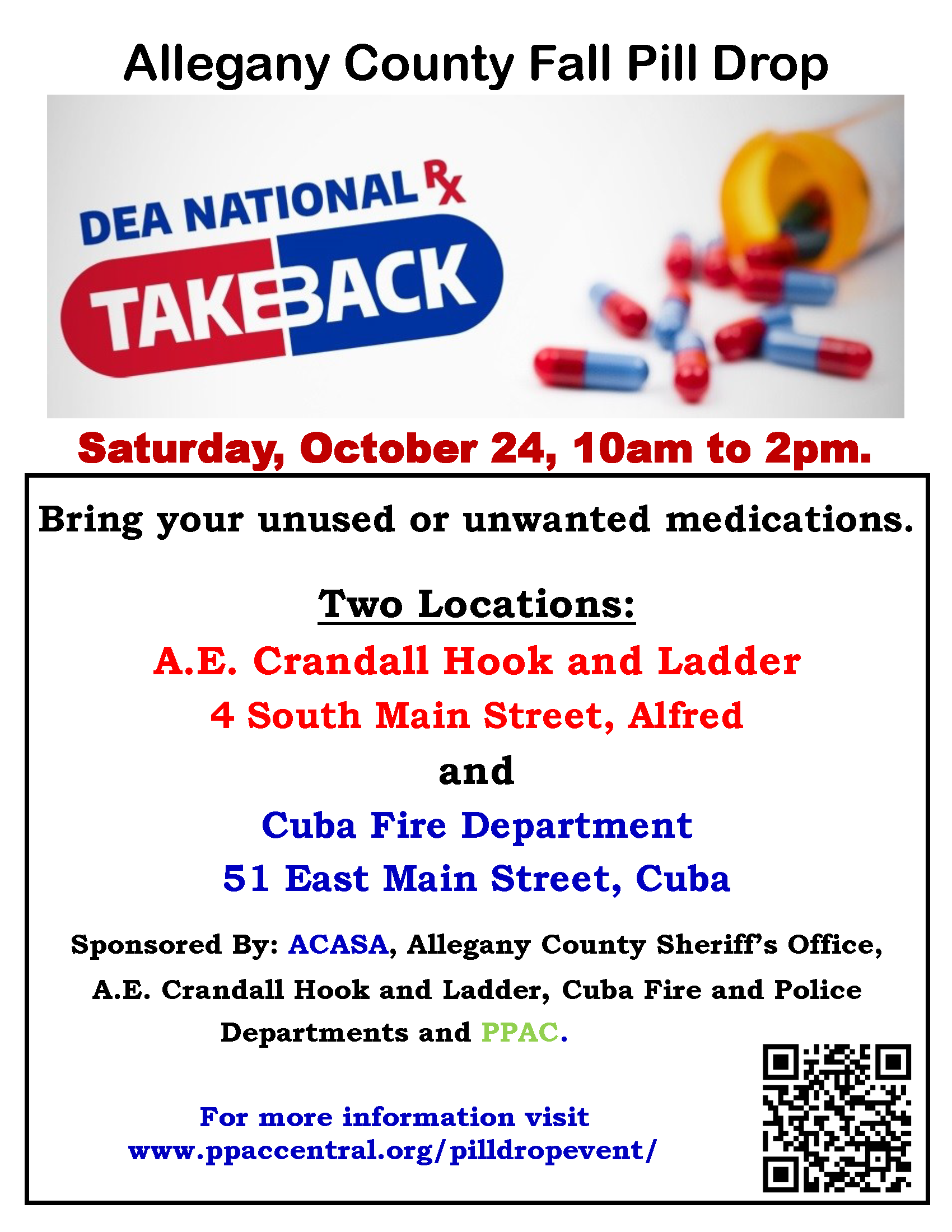
Allegany County Participates in DEA National Take Back Day

Belmont and Cuba – This past Saturday, the Allegany Council on Alcoholism and Substance Abuse, Inc.(ACASA), the Allegany County Sheriff’s Office, Belmont and Cuba Police Departments, and Partners for Prevention in Allegany County (PPAC) held the biannual pill drop event in conjunction with the Drug Enforcement Administration’s (DEA) National Take Back Day. Community members can bring unwanted or unused medications, needles, and e-cigarettes that need to be disposed of properly with no questions asked. The agencies use the pill drops to educate the community on the fourteen Take It to the Box locations throughout Allegany County, that are used for disposal of medications year-round for free. The partners also educate about the availability to dispose of needles at any of the Allegany County transfer stations for free. Community members are asked to put needles into a puncture proof container such as a laundry detergent bottle with the cap tightly secured. Allegany County is one of the very few counties in New York that offers this no-cost service.

Belmont and Cuba locations were chosen for to be the Fall pill drop locations by members of PPAC’s Environmental Strategies committee. “The purpose of holding the pill drops is to offer community members the opportunity to dispose of their medications safely, but also educate them about other resources available to them,” states PPAC Coalition Coordinator Jon Chaffee. “It is important for people to not hold onto medications that they are no longer using because studies have shown that youth and adults who abuse medications usually get them from friends or family members without their knowledge,” states Chaffee.

Cuba Police Officer Kendra Waters and ACASA’s Director of Prevention Kim Strauser at the Cuba Pill Drop location.

This year 14 cars came to the two locations to drop off over ninety pounds of medications. Even though the pill drops do not collect as much medications as in the past the Take It to the Box locations have collected 774 pounds from May to October of 2023. Everyone who stops at the pill drops are educated about the local Take It to the Box locations nearest to them. Medication drop boxes can be found in Belmont at Nicholson Pharmacy and the Allegany County Sheriff’s Office, and in Cuba at the Cuba Pharmacy and Cuba Police Department.  All medications that are collected are taken to an incinerating location by the Sheriff’s Office in order to make the medications harmless to the environment and useless to people.

The next pill drop event will be held April of 2024. To find out where all the Take It to the Box locations are located throughout Allegany County visit www.ppaccentral.org/takeittothebox/. To find out where community members can dispose of needles or sharps properly visit www.ppaccentral.org/needledisposal/ .

Remember Prevention Works!

ACASA Kicks Off October with the Bob Weigand Annual Move-A-Thon

October is National Substance Abuse Prevention Month.  On Saturday, October 7th, the Prevention Department of the Allegany Council on Alcoholism and Substance Abuse, Inc., (ACASA) held the 25th annual Bob Weigand Memorial Move-a-Thon at the Angelica Village Office.  Thirteen people participated in this year’s Red Ribbon event, which is held every first Saturday in October in memory of Drug Enforcement Agent Enrique “Kiki” Camarena, who was killed by drug traffickers in 1985.  The purpose of the Move-a-Thon is to promote a drug-free lifestyle through healthy alternatives, and to remind people to wear red ribbons in support of a drug-free America during Red Ribbon Week, October 23rd-31st.  This year’s theme is: “Be Kind to Your Mind.  Live Drug Free”.  The National Family Partnership is holding their 13th annual photo contest for students, schools, and parents to raise visibility to live drug-free for a chance to win a iPad or $1,000 for their school. The first ten participants/families who registered at the Move-a-Thon were promised a free caricature drawn by our own local-gone-national celebrity, Eric Jones, once they submitted their photos to ACASA. 

Winners of the event by category are as follows:

  • First Place Female Walker was Domownae Grooms. 
  • First Place Male Walker was Benji Bond.
  • First Place Male Cyclist was Shawn Scholla. 
  • There were no female cyclists or runners present.

The Allegany Council would like to thank the Village of Angelica for allowing the event to take place there, and all those who participated in and supported this special event! For more information on the ACASA visit www.alleganycouncil.org

October is National Disability Employment Awareness Month

Observed in October, National Disability Employment Awareness Month (NDEAM) is a nationwide campaign celebrating the many and varied contributions of America’s workers with disabilities. In recognition of the important role people with disabilities play in a diverse and inclusive American workforce, this year’s theme is “Advancing Access and Equity.”

NDEAM’s history dates back to 1945, when Congress declared the first week in October each year as “National Employ the Physically Handicapped Week.” In 1962, the word “physically” was dropped to acknowledge people with all types of disabilities. In 1988, the federal legislature expanded the week to a month and changed the name to National Disability Employment Awareness Month.

“National Disability Employment Awareness Month is a national initiative designed to increase the employment of people with disabilities,” said Amber Parker, The Arc Allegany-Steuben’s Director of Vocational Services. “Every day, people with disabilities can and do add value to America’s workplaces. The NDEAM campaign’s goal is to drive positive change through the hiring, retention and advancement of people with disabilities in America’s workforce and by illustrating that at work, it’s what people can do that matters.”

“There are a variety of potential financial incentives that a business may utilize when they employ people with disabilities such as the Federal Work Opportunity Tax Credit, NYS Workers with Disabilities Employment Tax Credit, Work Try-Out, On-The-Job Training, Job Coach Services, Architectural/Transportation Tax Deduction and Small Business Tax Credit,” said Parker. “With so many businesses hiring, it is important to look everywhere for talent. Recruiting should extend to nontraditional sources, including people with physical, mental, and communication disabilities. If you are interested in diversifying your business, please contact me at 585-808-2856.”

Learn how The Arc Allegany-Steuben’s ACHIEVE Career Consultants provide multiple avenues for people with intellectual and developmental disabilities to prepare for and become successful members of the workforce community through avenues such as community and vocational assessments, school to work programs, job placement, supported employment and on-site simulated job training experiences by visiting www.thearcas.org.

34th National Recovery Month

This September marks the 34th National Recovery Month, an observance held every September to promote and support new evidence-based treatment and recovery practices, the emergence of a strong and proud recovery community, and the dedication of service providers and community members across the nation who make recovery in all its forms possible. This year’s theme of celebration is “Join the Voices for Recovery: Together We Are Stronger.”    

As part of Recovery Month, #AddictionProfessionalsDay is celebrated on September 20, marking the 31st Anniversary since National Addiction Professionals Day was established by NAADAC (National Association for Alcoholism and Drug Abuse Counselors) in 1992 to commemorate the dedicated work that these vital players of the health system and continuum of care do on a daily basis. Visit National Recovery Month for more information.

According to information published by SAMHSA (Substance Abuse and Mental Health Services Administration), peer support workers are those who have been successful in the recovery process and are able to help others who are experiencing similar situations.  Through shared understanding, respect, and mutual empowerment, peer support workers help people become and stay engaged in the recovery process and reduce the likelihood of relapse.  Peer support services can effectively extend the reach of treatment beyond the clinical setting into the daily environment of those seeking a successful, sustained recovery process.  

Peer support workers engage in a wide range of activities that include advocating for people in recovery; sharing resources and building skills; building community and relationships; leading recovery groups; and mentoring and setting goals.  Peer support roles may also extend to providing services and/or training; supervising other peer workers; developing resources; administering programs or agencies; and educating the public and policymakers.

Peer support workers may need to develop additional core competencies to provide services to specific groups who also share common experiences, such as family members.  The shared experience of being in recovery from a mental health and/or substance use condition or being a family member is the foundation on which the peer recovery support relationship is built.

Previously, Recovery Month was sponsored by SAMHSA.  In 2020, the federal government “turned the reins over” to the recovery community to sponsor and manage this yearly observance.  Although SAMHSA remains an active Recovery Month Planning Partner and supporter, Faces & Voices of Recovery, a long-standing Recovery Month Planning Partner, now hosts the Recovery Month website, managing the social media outreach, developing and disseminating promotional materials, and is the central location for all Recovery Month events.  More information can be found at Recovery Month .

Local counseling is available at the Allegany Council on Alcoholism and Substance Abuse, Inc., at 585-593-6738.  Together, we can stop the stigma surrounding mental and substance use disorders, and help more people find the path to hope, health, and overall wellness! 

Submitted by: Ann Weaver, Community Educator at Allegany Council on Alcoholism and Substance Abuse, Inc.

Tobacco Companies Must Post Signs About Health Risks of Smoking

Messages, which started going up in retail stores in July, must be posted by September 30

Beginning July 1, the major U.S. tobacco companies  were mandated to post eye-catching signs telling the public the truth about the deadly consequences of cigarette smoking at about 220,000 retail stores across the nation that sell cigarettes.

“This is a long-overdue step in holding the tobacco industry accountable for decades of misleading the public with blatant liesthat led to addiction, disease and premature death for millions of people,” said Jonathan Chaffee, Reality Check youth coordinator for Tobacco-Free Chautauqua, Cattaraugus and Allegany Counties (TF-CCA).

Under a federal court order, said Chaffee, the signs must be installed near cigarette displays in stores by September 30 and must be displayed until June 30, 2025.

This order will fully implement the “corrective statements” the tobacco companies were first ordered to make in 2006, when U.S. District Judge Gladys Kessler issued a landmark judgment that these companies had violated civil racketeering laws and lied to the public for decades about the health risks and addictiveness of cigarettes and their marketing to children. The tobacco industry has fought the point-of-sale corrective statements in court for 16 years, but the parties to the case – including the U.S. Department of Justice, six public health organizations and the tobacco companies – negotiated an agreement for the corrective statement signs to be displayed in retail stores for 21 months.

The point-of-sale signs will tell the public the truth about the adverse health effects of smoking and secondhand smoke, the addictiveness of smoking and nicotine, and the industry’s manipulation of cigarettes to make them more addictive. Most important, this important information will be provided to consumers at the point where they are making decisions whether to purchase cigarettes.

The corrective statements have previously been disseminated through newspaper and television ads and on cigarette packs, and they continue to appear on tobacco company websites. The statements are intended to prevent and restrain future fraud by an industry that has lied to the American people for decades. For information on the corrective statements visit Counter Tobacco’s “Retailers Required to Post Tobacco Industry “Corrective Statements” at the Point of Sale .

About Tobacco-Free Chautauqua, Cattaraugus, Allegany Tobacco-Free Chautauqua, Cattaraugus, Allegany is funded through the New York State Department of Health, Bureau of Tobacco Control and is a part of Tobacco-Free Western New York, managed by Roswell Park Comprehensive Cancer Center. To learn more follow Tobacco-Free CCA on Facebook, Instagram, X formerly Twitter.